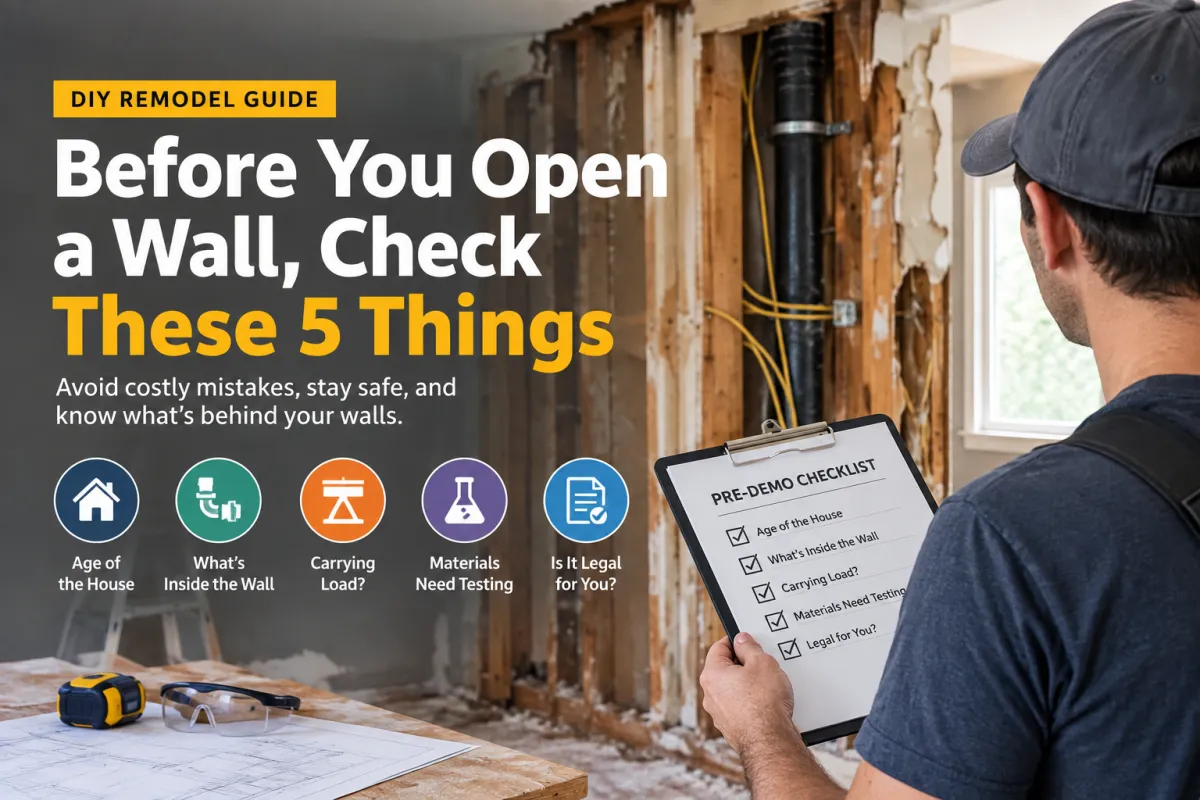
Before you open a wall, check five things: the age of the house, what's running inside the wall, whether it's carrying load, whether the materials need testing, and whether the work you're about to start is legal for you to do yourself
Before you open a wall, check five things: the age of the house, what's running inside the wall, whether it's carrying load, whether the materials need testing, and whether the work you're about to start is legal for you to do yourself. Twenty minutes of checking beats a week of undoing.
Demolition is the most satisfying day of a remodel and the most consequential. It's also the phase where a confident DIYer does the most irreversible damage, because everything behind that drywall was invisible when you made the plan.
Quick answer
Homes built before 1978 may contain lead-based paint; older homes may contain asbestos in a surprising range of materials. Test before you disturb.
Assume every wall has something in it until you've verified otherwise.
Load-bearing is not a judgment call you make from the floor. Get it determined.
Some work is legal to self-perform and some isn't. Check before, not after.
Check 1: How old is the house?
Age drives your entire risk profile, and it's the one fact you can establish before you touch a tool.
For homes built before 1978, lead-based paint is a live concern. The EPA's Renovation, Repair and Painting rule requires anyone paid to disturb painted surfaces in pre-1978 homes to be lead-safe certified. The rule does not apply to homeowners working on their own pre-1978 home — with three important exceptions. It does apply if you rent out all or part of the home, operate a childcare facility in it, or are renovating to resell for profit.
That homeowner exemption is a legal carve-out, not a safety opinion. Lead dust from sanding or demolition is hazardous to everyone in the house, especially children. The EPA publishes lead-safe work practices for owner-occupied projects, and following them is the right call whether or not the rule compels you.
Asbestos is the other age-related concern and it shows up in more places than people expect: floor tile and the mastic under it, sheet vinyl backing, joint compound, textured ceilings, pipe and duct wrap, siding, and roofing. It's not something you identify by looking. Suspect materials should be tested by a qualified lab or assessed by a licensed professional before disturbance, and abatement rules vary by state.
Check 2: What's inside the wall?
Before the first cut, find out what's in there. Layered approach, cheapest first:
Read the house. Outlets, switches, and fixtures tell you where circuits run. A plumbing fixture on the other side of the wall, or directly above, tells you what's likely inside it. Vents mean ducts.
Scan it. A stud finder with AC detection and a decent metal setting will find framing, conduit, and pipe. Scan a wide area, not just where you plan to cut.
Open small first. Cut an inspection hole with a drywall saw at limited depth and look with a flashlight and a mirror or an inexpensive inspection camera. A patchable 6-inch hole is cheap insurance.
Kill power before cutting. Turn off the circuits you believe serve the area, then verify dead with a tester at the nearest device. Older homes frequently have circuits that don't follow the panel labels.
Assume gas lines can be in walls. If you find one, stop and get a licensed plumber or gas fitter. That's not a caution — that's a hard stop.
Check 3: Is it carrying load?
Load-bearing determination is not something to settle by opinion, by what a neighbor says, or by which direction the joists appear to run in the attic. The usual clues — a wall running perpendicular to the joists, a wall stacking over a beam or a wall below, a wall near the center of the span — are indicators, not conclusions.
Removing a bearing wall requires proper temporary shoring, a correctly sized header or beam, adequate bearing at both ends, and a load path that continues down to the foundation. That is engineering work, it usually requires a permit, and in many cases it requires a stamped design. It is also the single most common place where a DIY remodel causes damage that shows up months later as sagging floors and cracked drywall upstairs.
Check 4: The pre-demo test list
Run this before demolition day, not during it.
Condition | When to check | Who checks |
|---|---|---|
Lead-based paint | Home built before 1978, painted surfaces being disturbed | Certified lead inspector or risk assessor; EPA-recognized test kits for screening |
Asbestos-containing materials | Older homes; suspect flooring, texture, joint compound, pipe or duct wrap | Accredited lab sampling or licensed assessor |
Mold and moisture | Any known leak, stain, musty odor, or wet-area demolition | Qualified assessor if area is significant or occupants are sensitive |
Active circuits and gas | Every wall, every time | You, with a tester — verify dead, don't assume |
Buried utilities | Any digging at all, including fence posts and planting | Contact 811, the free national before-you-dig service, a few business days ahead |
Check 5: Are you allowed to do this yourself?
Self-performing work on your own home is legal in most places, within limits. The limits are worth knowing before you're standing in a pile of drywall.
Two separate questions apply. First, does the work require a permit? Second, does your jurisdiction allow a homeowner to perform and permit that work? Some states tie the two together tightly. Arizona's Registrar of Contractors, for instance, states that a license is generally required when labor and materials exceed $1,000 or when a permit is required regardless of price. Rules and owner-builder allowances vary substantially by state, so confirm yours before you commit.
The honest DIY screen
Here's the test that has saved more homeowners more money than any tool ever will. Ask: if I get this wrong, what's the worst outcome?
Cosmetic consequence — bad paint line, uneven tile. Redo it and learn. Good DIY territory.
Money consequence — ruined material, a callback for a pro to fix. Reasonable if you accept the risk.
Structural, life-safety, or water consequence — gas, electrical service, load-bearing, roof, anything that can burn, fall, or leak inside a wall for two years. Hire it out. Not because you can't learn it, but because the first attempt is the wrong place to learn it.
Plenty of homeowners can do excellent demolition work. The skill isn't in the swing — it's in knowing where to stop.
Your action plan
Confirm the year the home was built. Assessor records or your closing documents will have it.
Test for lead and asbestos where the age and materials warrant it, before anything gets disturbed.
Scan the wall, cut a small inspection opening, and verify circuits are dead.
Get the load-bearing question answered by someone qualified to answer it.
Confirm permit and licensing requirements with your building department.
Set up containment and protection before demolition, not after the dust is airborne.
Frequently asked questions
How do I know if a wall is load-bearing?
Indicators include running perpendicular to floor or ceiling joists, stacking above a beam or a wall on the level below, and sitting near the center of the structure's span. These are clues, not proof. Confirm with a structural engineer or your building department before removing anything, since the consequences of guessing wrong are structural and expensive.
Do I need to test for asbestos before remodeling?
If your home is older and you're disturbing suspect materials — floor tile and mastic, textured ceilings, joint compound, pipe or duct insulation — testing before disturbance is the responsible path. Asbestos can't be identified visually. Sampling and abatement requirements vary by state, so check your local rules.
Does the EPA lead rule apply to me if I'm doing the work myself?
The RRP rule does not apply to homeowners doing work in their own pre-1978 home, but it does apply if you rent out any part of the home, run a childcare facility there, or are renovating to resell for profit. Regardless of the rule, lead-safe work practices protect the people living in the house.
What tools do I need before opening a wall?
A stud finder with AC detection, a non-contact voltage tester plus a contact tester to verify dead, a drywall saw or multi-tool with depth control, a flashlight, and respiratory and eye protection appropriate to the material. An inexpensive inspection camera pays for itself the first time.
What should I do if I find something unexpected behind the wall?
Stop, photograph it, and don't cover it. If you're working with a contractor, that documentation becomes the basis for a written change order. If you're on your own, it's the moment to get an opinion from the appropriate trade before you keep going.
Is demolition a good first DIY project?
It can be, once you've cleared the checks above and set up containment and disposal. Demolition is unforgiving of assumptions but forgiving of a slow, deliberate pace. Go one layer at a time and look before every cut.
Keep going
Find something behind the wall and you're into change-order territory — see how change orders work on a remodel. And confirm whether your project needs a permit before demolition day, not after.
Plan your project with better information.
Smart Tools Construction Academy turns construction experience into practical tools for homeowners, owner-builders, and renovation investors.
Get Your Free Home Remodeling Guide
This content is provided by Smart Tools Construction Academy for general educational purposes. It is not project-specific construction, engineering, architectural, legal, tax, environmental, or safety advice. Codes, permits, licensing rules, costs, conditions, and accepted practices vary by project and jurisdiction. Consult the applicable building department and qualified licensed professionals before making project decisions or performing hazardous or regulated work.